-
Distribution of Slaves in 1825 (From Fogel, p.30)
                   % Total Imported Slaves    Distribution in %
                    16th - 19th Centuries      Slaves in 1825

    U.S.                     6                        36
    Brazil                  38                        31
    British Caribbean       17                        15
    Spanish America         17                        11
    French Caribbean        17                         4
    Others                   6                         2
The table implies that, relative to other slave importing countries/colonies,
slavery in the U.S. was not as harsh.For example, more Slaves were imported into Haiti, Cuba, and Jamaica than to the U.S.
The difference is primarily due to Sugar -- almost 70% of all imported slaves into the Western Hemisphere were sent to the various sugar colonies and the working conditions in the sugar colonies were very harse.
Europeans became familar with sugar as a result of the Crusades (Sugar Cane was grown in Palestine).
The Europeans first cultivated sugar cane in Cyprus, Crete, and Sicily using White slave labor during the 12th to 15th Centuries. It was in these colonies that Europeans developed the institutional apparatus they later used in the Caribbean.
The increasing demand for sugar led the Spanish and Portugese to islands off the African coast where they began to cultivate sugar cane using African slave labor.
By 1600 focus shifted to the New World and Brazil was temporarily the leading supplier of sugar.
Spanish and Portugese monopolized sugar production until 17th Century when the British, French, and Dutch moved into the Caribbean and established sugar colonies (Haiti, French; Barbados and Jamaica, English; etc.).
-
Sugar was not an important product in the South. What made slavery so
profitable was the invention of the Cotton Gin by Eli Whitney in 1793.

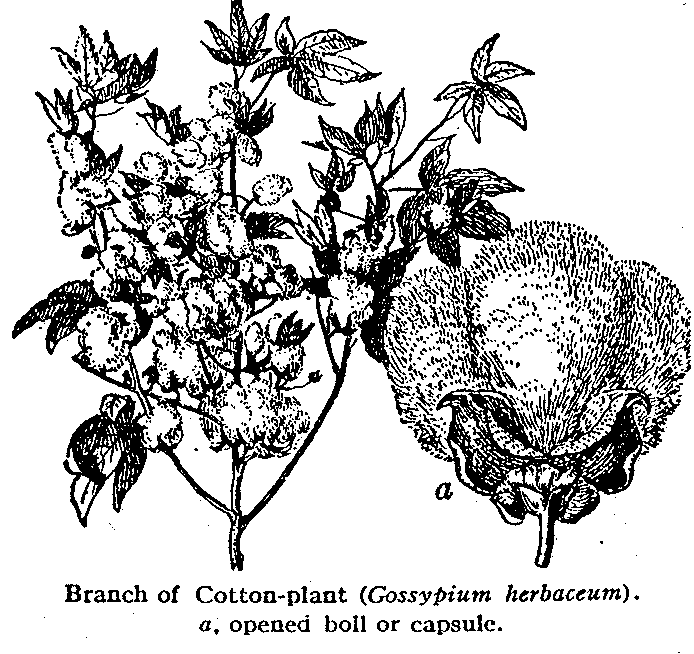
The Cotton Gin was a simple device that, in effect, worked like a "comb". The Cotton was forced through the comb which allowed the cotton fibers to pass through but not the seeds. The Cotton Gin instantly lowered the labor costs of growing cotton and resulted in huge efficiencies.
By 1860, 90% of Slaves were engaged in the production of Cotton.
-
The publication of Time on the Cross in 1974 changed forever our understanding
of the economics of Slavery.
Fogel and Engerman's work touched off a huge controversy at the time. However, their work has stood the test of time and has been largely confirmed by subsequent work.
Was Slavery Profitable? Yes. The return on an investment in slaves was as much as other available investments
Would Slavery Have Died out of its own Accord? No. The tides of history were clearly running against slavery but it would have been many years before it was replaced in the South.
Was the Southern Economy Stagnant? No. The "Old South" was growing slower than the Northeast, but the "New South" -- LA, TX, MS, AR -- was growing very rapidly.
-
By 1860 Cotton exports were $192m or four times U.S. Government revenues
England imported about 80% of its Cotton from the South and about 1.5m people were employed in English textile mills.
86% of the Cotton was grown on farms of 100 or more acres.
By 1860 Slavery was the Cotton system.
The expansion of the Cotton-based Slavery system into the Southwest accounts for much of the potency of the Territorial Issue.
What Made the Cotton System so efficient:
-
Speed-up and Specialization of Slave Labor -- Example: A Planting Gang
consisted of 5 men (sometimes some women were used) who went through the field
in single file. The first man -- plowman -- ridged up the unbroken earth;
the second man -- harrower -- broke up the clods; the third man --
driller -- created holes for the cotton seeds; the fourth man -- dropper --
planted the seeds; and the fifth man -- raker -- covered up the holes.
Drivers roamed the fields making sure that the work pace was brisk.
Labor Specialization was also by age. Elderly women were used to care for children and the sick, as seamstresses, etc. Elderly men were used to care for livestock, as gardners, and servants.
This Labor specialization shows up in auction price records. The price of male slaves was still positive even at age 70. (Fig. 11, Fogel)
Self Sufficiency of Plantations -- Some land was used for growing corn and wheat. Corn was planted in Feb./March and Cotton in April. Corn could be left in the field until after the Cotton was picked. During the winter labor was used to repair roads, maintenance, etc.
-
Diet: The typical slave was well fed. The core diet was corn, pork, and
potatoes (mostly sweet). Average daily diet was about 1.1 times free northern
males in energy content and exceeded 1964 recommended levels of chief
nutrients. Height records of adults show near normal stature. Adult slaves
were taller in stature than workers in many European countries.
Housing: 5.2 Slaves per House (Cabin) on large plantations. In northern cities, it was 5.3 persons per house/living quarters.
The family unit was encouraged.
Clothing: coarse but durable cloth.
-
By universal agreement, the importing of slaves into the U.S. was to end
by 1808 (written into the Constitution). A law passed in 1807 to enforce the
import ban required all vessels in the coastal trade to keep detailed records
of all slaves brought aboard ship.
Steckel found that the records clearly showed widespread malnourishment of children 6 years and younger. They were unusually short with distended bellies -- the classic signs of malnutrition.
Steckel's findings seemed to be inconsistent with those of Fogel and Engerman. Why were the adults treated so well yet the children were malnouished?
The explanation appears to be ignorance, not design. Children were weaned early so that the mothers could be put back to work. After weaning, children were typically fed porridge which did not provide them with enough protein. However, around the age of 6 children were put into "children's gangs" to do light work and began eating out of the same pot that the adults ate from. Consequently, they began to gain weight and by the time they were teenagers they were of near normal stature.
As a consequence, child mortality was high and it is highly probable that this produced mental retardation in many slaves.
In addition, the fertility of slave women was very high. The population growth rate was close to that of Whites but slave women lost about 1/2 of their children through miscarriage or in early infancy.
-
Financing the movement of Cotton before the Civil War was a major
undertaking -- much like financing the movement of OPEC oil in today's world.
British Factors (agents), working for a variety of banks, financial houses, and importing firms were located at nearly every major production center and port in the South. They paid for the Cotton in cash on the spot using sterling Bills of Exchange.
These bills of exchange were then sold to importers (mostly Northern)
who used them to finance imports.

 VOTEVIEW Blog
 Course Web Pages: University of Georgia (2010 - )
 Analyses of Recent Politics