H1: m = m1 > mo
Test: If  > mo + c then reject Ho
-
To find c when s2 is known

To find c when s2 is not known, large sample

To find c when s2 is not known, small sample from N(m, s2)

H1: m ¹ mo
Test: If
 > mo + c or
-
> mo + c or
-  < mo
- c then reject Ho.
< mo
- c then reject Ho.
-
To find c when s2
is known

To solve for c (a) fix a (c) and use Z table.
To find c when s 2 is not known, large sample

To solve for c (a) fix a (c) and use Z table.
To find c when s2 is not known, small sample from N(m , s2)

Where T has a t distribution with n - 1 degrees of freedom. To solve for c (a) fix a (c) and use t table.
H1: m1 - m2 ¹ 0
Test: If

 then reject Ho.
-
To find c when
s12 and
s22
are known
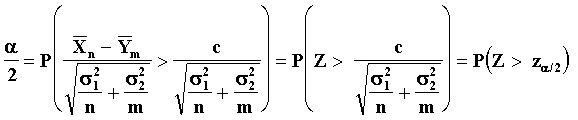
To solve for c (a) fix a (c) and use Z table.
To find c when
 are not known, large sample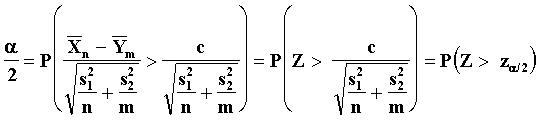
To solve for c (a) fix a (c) and use Z table.
To find c when
are not known, small samples from N(m
, s2)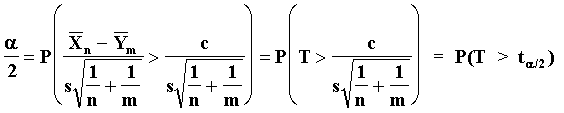
Where T has a t distribution with n + m - 2 degrees of freedom and s2 is given by:
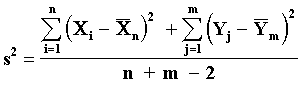
To solve for c (a) fix a (c) and use t table.

H1: s2 =

Test: If
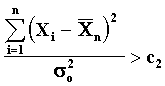 then reject Ho.
To find c2 set
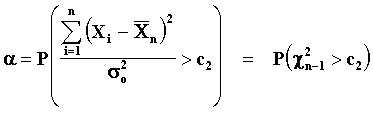
and use the chi-square table with n - 1 degrees of freedom.
Ho: s2 =

H1: s2 =

Test: If
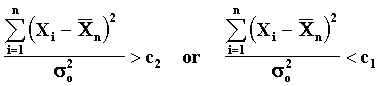 then reject Ho.
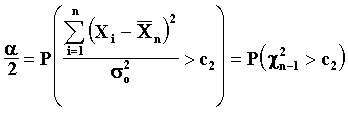
To find c1 and c2 set
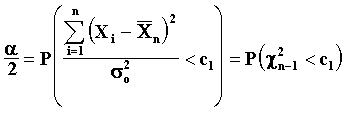
Ho:

H1:

Test: If
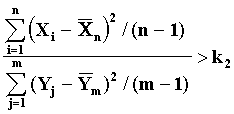
 or
or 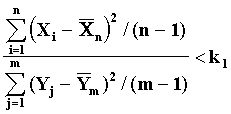
then reject Ho. To find k1 and k2 set
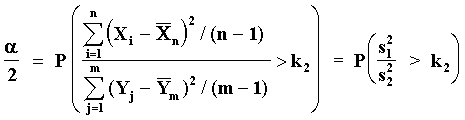
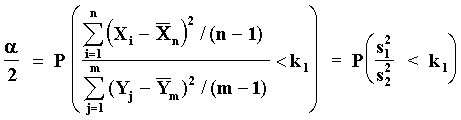
Use the F table with n - 1 and m - 1 degrees of freedom to find k2 and then use the reciprocal of the entry for m - 1 and n - 1 degrees of freedom for k1.