(June 2006, MIT Press)
Nolan McCarty, Keith T. Poole, and Howard Rosenthal
Abstract
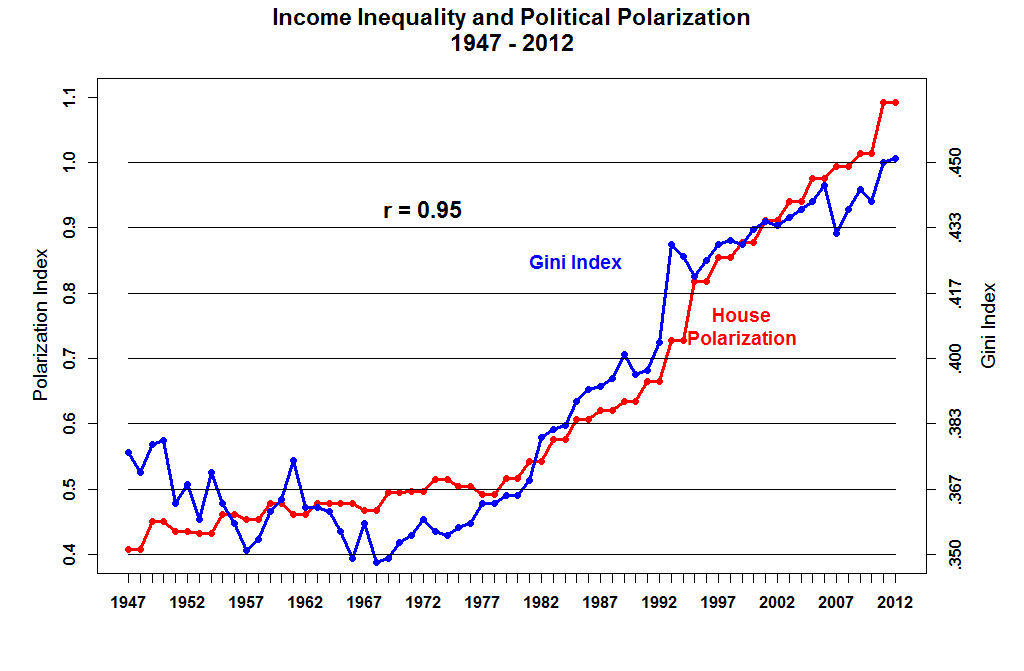
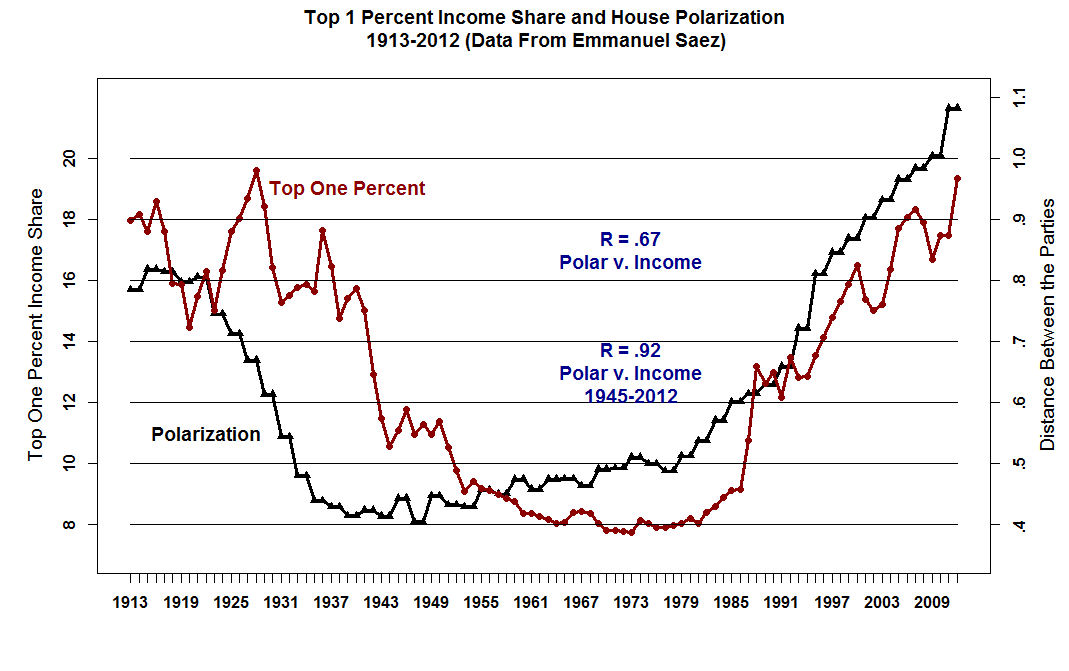
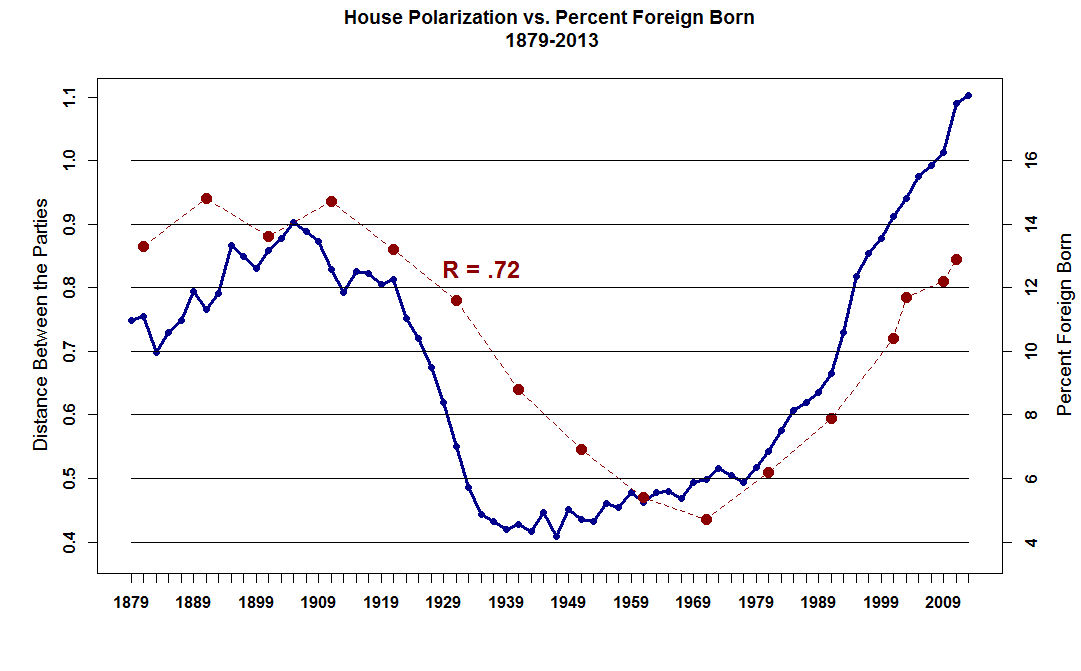
Political polarization, income inequality, and immigration have all
increased dramatically in the United States over the past three
decades. The increases have followed an equally dramatic decline in
these three social indicators over the first seven decades of the
twentieth century. The pattern in the social indicators has been
matched by a pattern in public policies with regard to taxation of
high incomes and estates and with regard to minimum wage policy. We
seek to identify the forces that have led to this observation of a
social turn about in American society, with a primary focus on
political polarization.
Our primary evidence of political polarization comes from analysis of
the voting patterns of members of the U.S. House of Representatives
and Senate. Based on estimates of legislator ideal points (Poole and
Rosenthal 1997 and McCarty, Poole, and Rosenthal 1997), we find that
the average positions of Democratic and Republican legislators have
diverged markedly since the mid-1970s. This increased polarization
took place following a fifty-year blurring of partisan divisions.
This turning point occurs almost exactly the same time that income
inequality begins to grow after a long decline and the full effects of
immigration policy liberalization are beginning to be felt.
Some direct causes of polarization can be ruled out rather quickly.
The consequences of “one person, one vote” decisions and redistricting
can be ruled out since the Senate, as well as the House of
Representatives, has polarized. The shift to a Republican South can
be ruled out since the North has also polarized. Primary elections
can be ruled out since polarization actually decreased once primaries
became widespread.
It is more difficult to find the causes of polarization than to reject
them because social, economic, and political phenomena are mutually
causal. For example, immigration might lead to policies that increase
economic inequality if immigrants are at the bottom of the income
distribution and do not have the right to vote. We document an upward
shift in the income distribution of voting citizens. In turn,
dispersal in income might lead to polarization. It also might lead to
laxity toward immigration if inexpensive immigrant labor in the form
of domestic and service workers is a complement to the human capital
of the wealthy.
In additional to our focus on the polarization of elected
office-holders, we look at patterns of polarization among economic
elites. By examining campaign contributions, we find very high levels
of polarized giving. While some billionaires clearly spread their
contributions to both parties to buy access, increasing numbers
concentrate their largess on the ideological extremes. This polarized
campaign giving, coupled with the emergence of the soft money loophole
has arguably contributed to the ideological extremism of political
parties and elected officials.
Finally, we also examine polarization among the electorate. While it
is fairly clear that the views of most citizens have not become more
extreme, those with strong partisan identifications have (DiMaggio, et
al., Fiorina). Consistent with other findings (King, Jacobson), we
find that partisans are more likely to apply ideological labels to
themselves and a declining number of them call themselves moderate.
Strong party identifiers are the most likely to define politics and
ideological terms while the differences in the ideological
self-placements of Republicans and Democrats have grown dramatically
since the 1980s. Given Bartels’ findings that partisanship has become
a better predict of vote choice, this polarization of partisans has
contributed to much more ideological voting behavior.
We also find that the polarization of the electorate has increasingly
taken place along economic or class lines. Unlike the patterns of the
1950s and 1960s, upper income citizens are more likely to identify
with and vote for Republicans than are lower income voters. However,
we find that class polarization is most likely a result of the
ideological shift of the Republican Party towards a more economic
libertarian position. This shift to the right was aided by a number
of social, political, and economic factors. First, as American
society has become wealthier on average, a larger segment of society
prefers to self-insure rather than depend on government social
programs. Such voters have become more attracted to the Republicans
and their agenda for an “Ownership Society.” Second, due to patterns
of immigration and incarceration, members of lower income groups are
less likely to be part of the electorate. This has the effect of
moving the median income voter closer to the mean income citizen,
reducing the demand for redistribution (Romer, Meltzer and Richard).
Third, middle-income voters in the so-called “Red states” increasingly
sympathize with Republican positions on social, cultural, and
religious issues (e.g. Franks). The Republican advantage on these
issues has mitigated any loss of votes that might have been associated
with their shift on economic issues. Finally, the emergence of a
class-based, two-party system in the United States has benefited the
Republicans and mirrored the patterns of economic polarization found
in other regions.
Finally, we examine the policy consequences of the fall and rise of
political polarization. The separation of powers makes it difficult
to generate coalitions large enough to produce policy change even when
opinion shifts. We exploit this observation to get some leverage in
disentangling the effects of political, economic, and social policies.
For much of the period when polarization fell, immigration policy was
restrictive and unchanged while income and estate taxes, defined in
nominal terms, became more onerous. For the period since the onset of
renewed polarization, we find strong evidence that “gridlock” has
resulted in a less activist federal government. The passage of new
laws has been curtailed due to the increasing difficulty of generating
the requisite bipartisan coalitions. The effects on social and tax
policy have been especially dramatic as real minimum wages have
fallen, welfare devolved to the states, and tax rates have diminished.
We also show how polarized politics has affected administrative and
judicial politics.
(Of related interest! Note the Patterns. Added, July 2011)
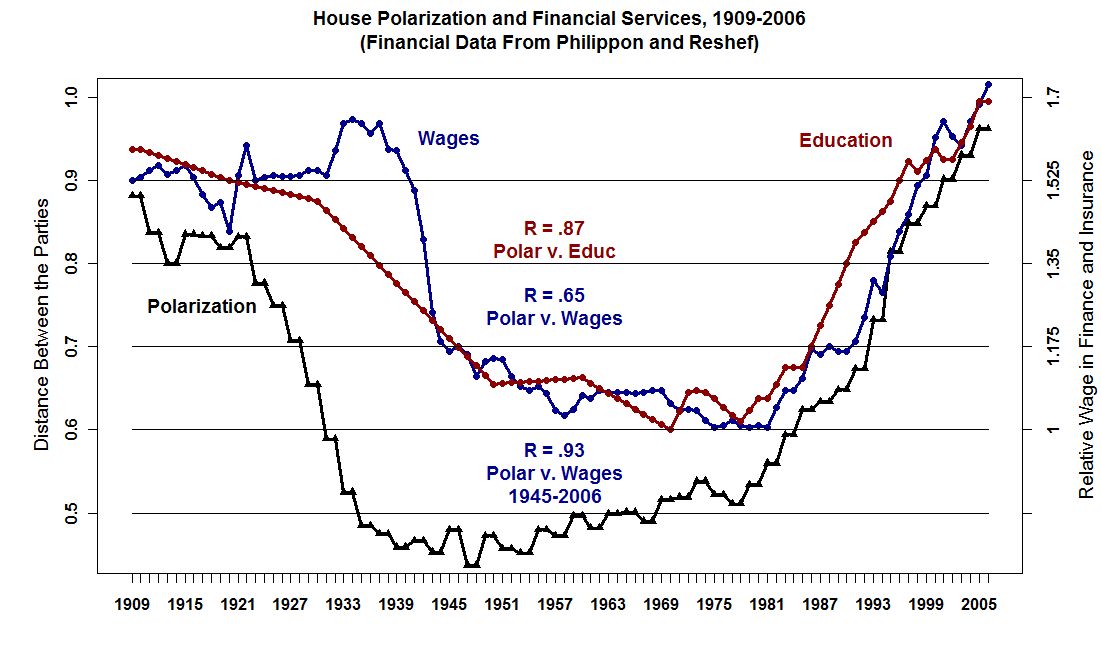
Party Polarization: 1879 - 2015
 McCain For President?
  The Next
Big Issue: Inequality in America, by Godfrey Hodgson
The Next
Big Issue: Inequality in America, by Godfrey Hodgson